
Measuring Coax Length with an Oscilloscope
Finding the length of a coil of coax without unrolling it, using a pulse, a scope and a little arithmetic.
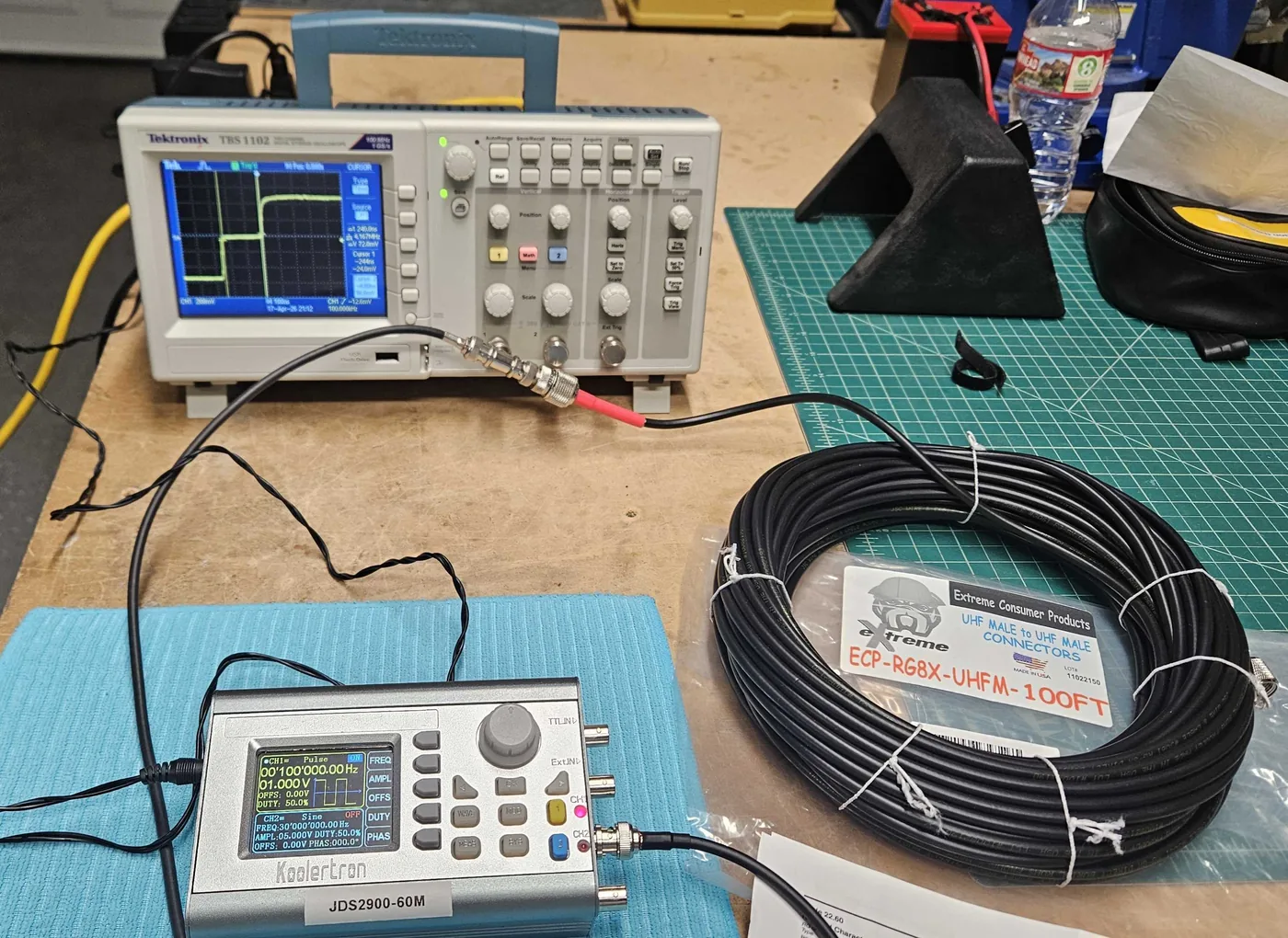
At a Henderson Amateur Radio Club (HARC) breakfast, Larry, K7MLG, gave a lesson on measuring an unknown length of coax with a signal generator and an oscilloscope. In the spring of 2026 I tried it on a newly acquired coil of RG-8X sold as 100 feet. It measured about 98 feet.
The idea is simple: send a pulse into one end of the cable and time how long the echo takes to come back from the far end. Knowing how fast a signal travels in that cable, the time gives the length. The proper name for this is time-domain reflectometry, or TDR.
1. The setup
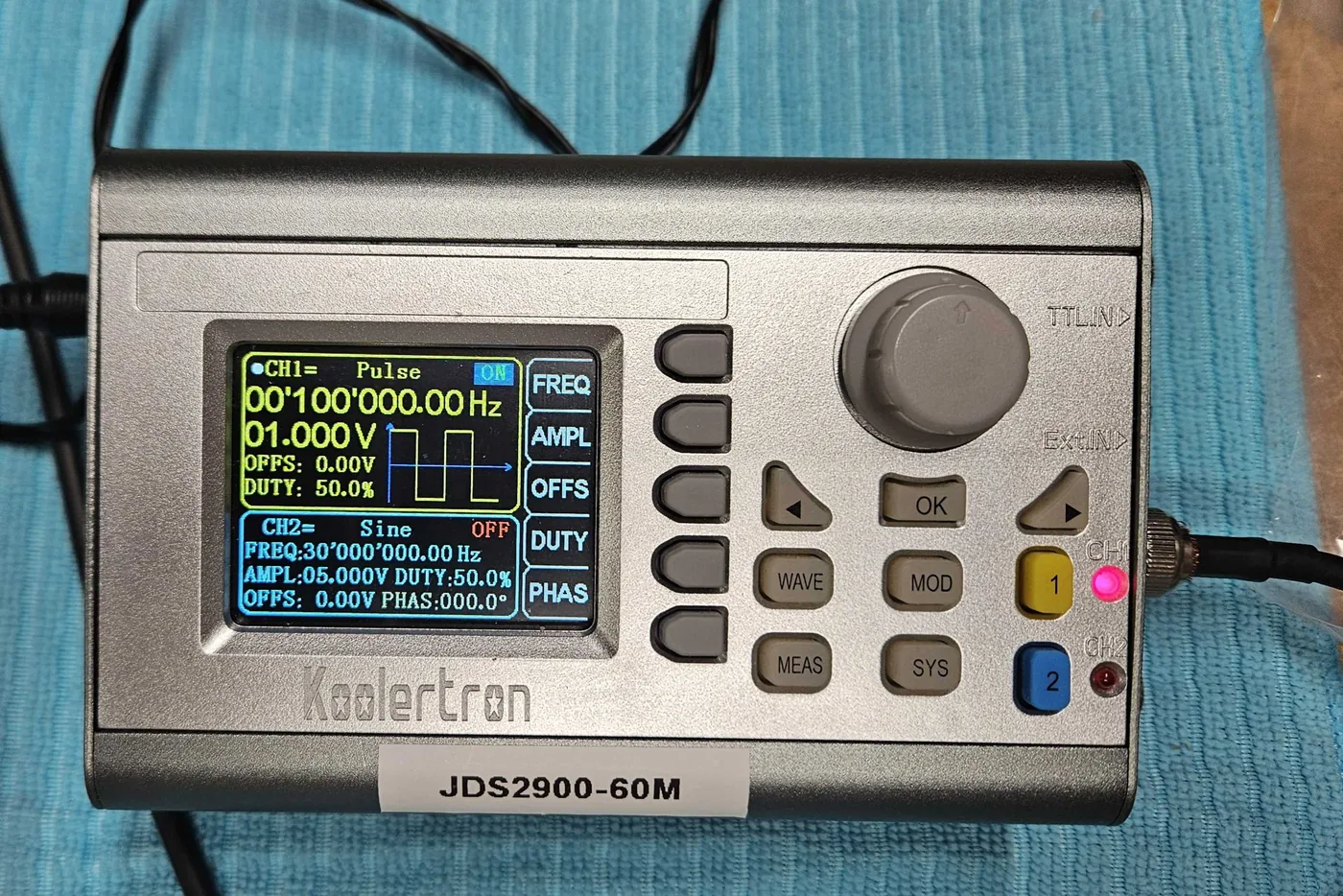
- Signal generator. Set to a 100 kHz pulse (a square wave), 1 volt, 50% duty cycle.
- A tee at the scope. The generator and the coax both connect to channel 1 of the scope, so the scope sees what goes into the cable and what comes back out of it.
- Far end open. Nothing is connected to the other end of the coax.
The exact frequency isn't important. Each pulse only has to last much longer than the echo takes to return, and at 100 kHz each one lasts 5,000 nanoseconds.
2. What the scope shows
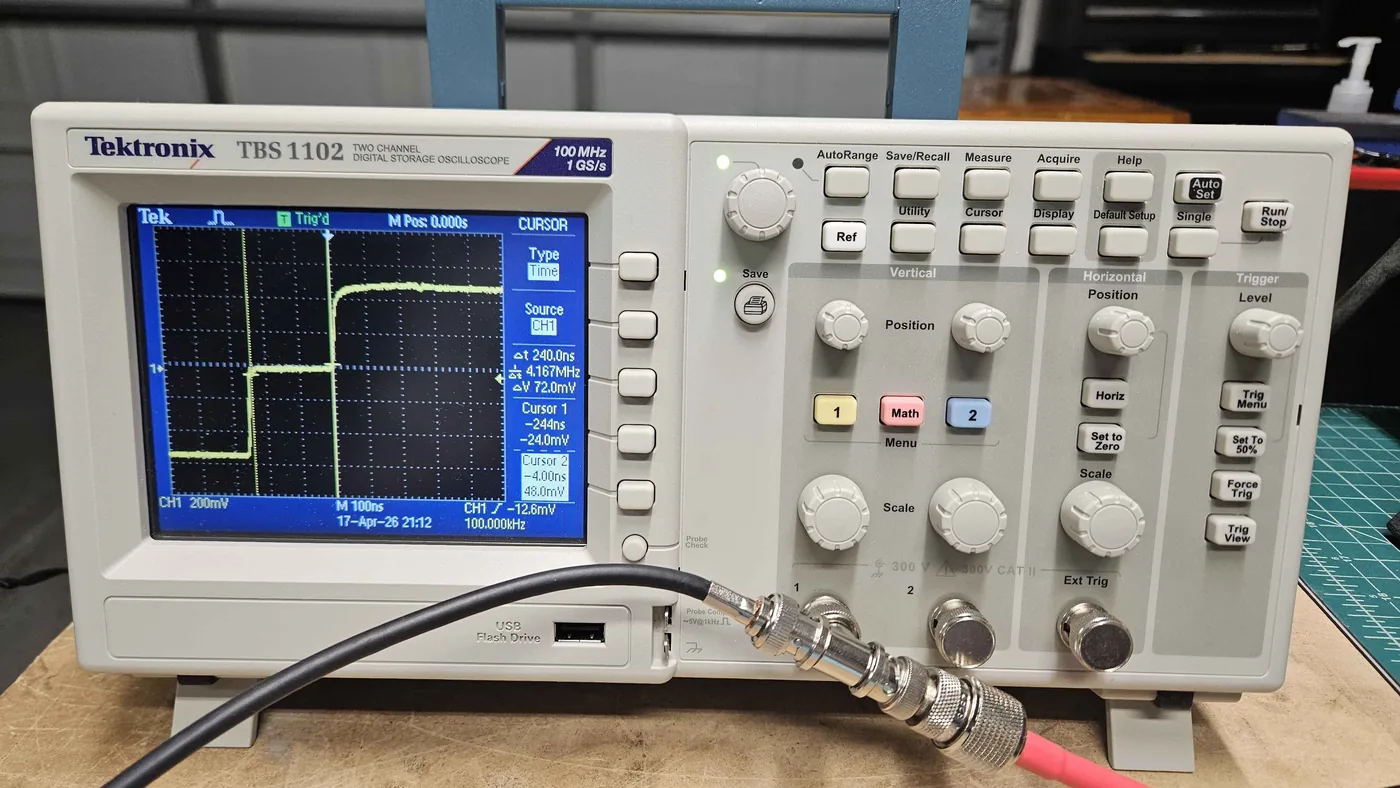
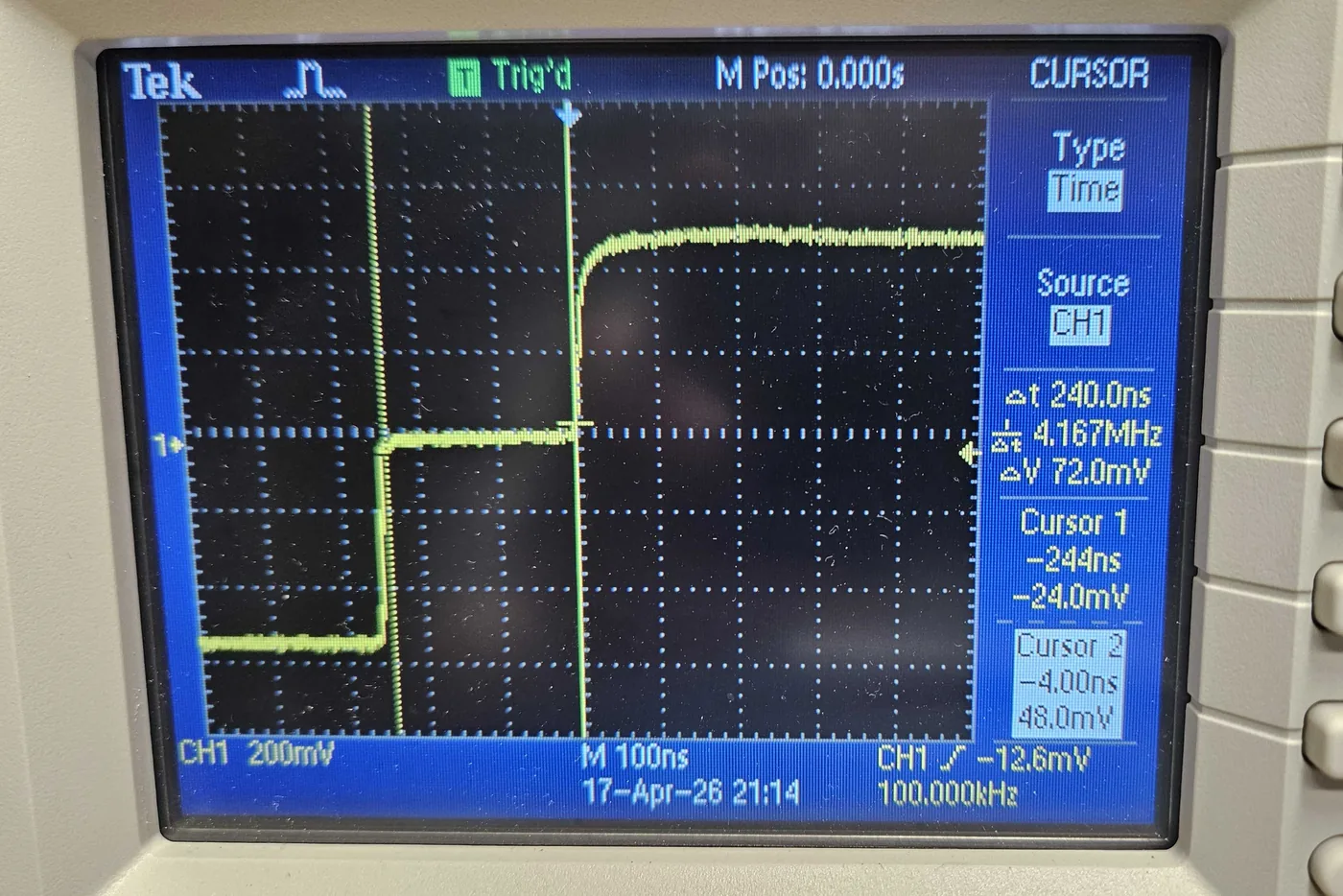
Instead of jumping straight to full height, the rising edge of the pulse climbs in two steps, with a flat shelf halfway up.
The shelf is the pulse on its way down the cable and back. While it is traveling, the cable looks like a 50 ohm load to the generator. The generator's own output is 50 ohms as well, so only half of the voltage shows up at the scope. At the open far end the pulse has nowhere to go and bounces back. When that echo arrives at the scope, the voltage rises the rest of the way.
So the width of the shelf is the time for one round trip. Using the scope's vertical cursors, one on each rising edge, it measured 240 nanoseconds.
3. The math
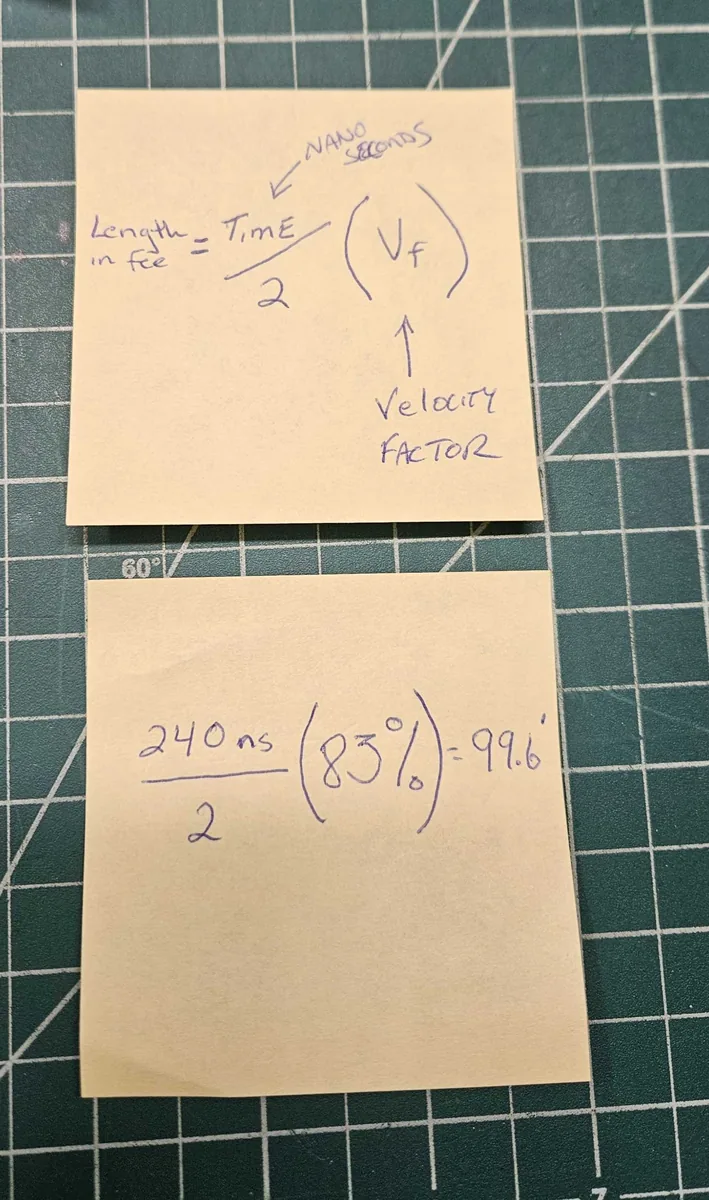
A signal in coax travels slower than light. How much slower is the cable's velocity factor, and it depends on the insulation inside. Published figures for RG-8X run from 80% to 86% depending on who made it, so I used 83%.
Light travels 0.984 feet in a nanosecond. The time is divided by 2 because the pulse covers the cable twice, out and back.
length in feet = time in ns ÷ 2 × velocity factor × 0.984
240 ÷ 2 × 0.83 × 0.984 = 98.0 feet
On the bench I used a shortcut. Light travels so close to one foot per nanosecond that I left the last number out, which gave 99.6 feet. The shortcut reads about 1.6% long, which is fine for a quick check.
4. How close is it?
- The velocity factor is the biggest unknown. I don't have the maker's figure for this cable. At 80% the same 240 ns works out to about 94 feet, and at 86% to about 102 feet.
- The cursors move in 4 ns steps. One step is worth about 1.6 feet of cable.
- It works the other way too. If the cable really is 100 feet long, then 240 ns means its velocity factor is about 85%. Measuring a piece of known length is a good way to find the velocity factor of a cable.
- It can find faults. A short in the cable makes the shelf drop back to zero instead of stepping up, and the width of the shelf still gives the distance to it.
Either way, the result is well within what this method can tell: the coil is the 100 feet it was sold as, give or take a few feet.
Equipment
- Tektronix TBS 1102 oscilloscope (100 MHz, 1 GS/s)
- Koolertron JDS2900-60M signal generator
- BNC tee and a BNC to UHF adapter
- Cable tested: Extreme Consumer Products RG-8X, 100 feet, with a UHF male (PL-259) connector on each end
Velocity factors are from Table 22.60, “Nominal Characteristics of Commonly Used Transmission Lines,” in The ARRL Handbook. Thanks to Larry, K7MLG, for the lesson.